AI Agents vs. Chatbots: Why Custom Beats Generic
By Tom Meredith
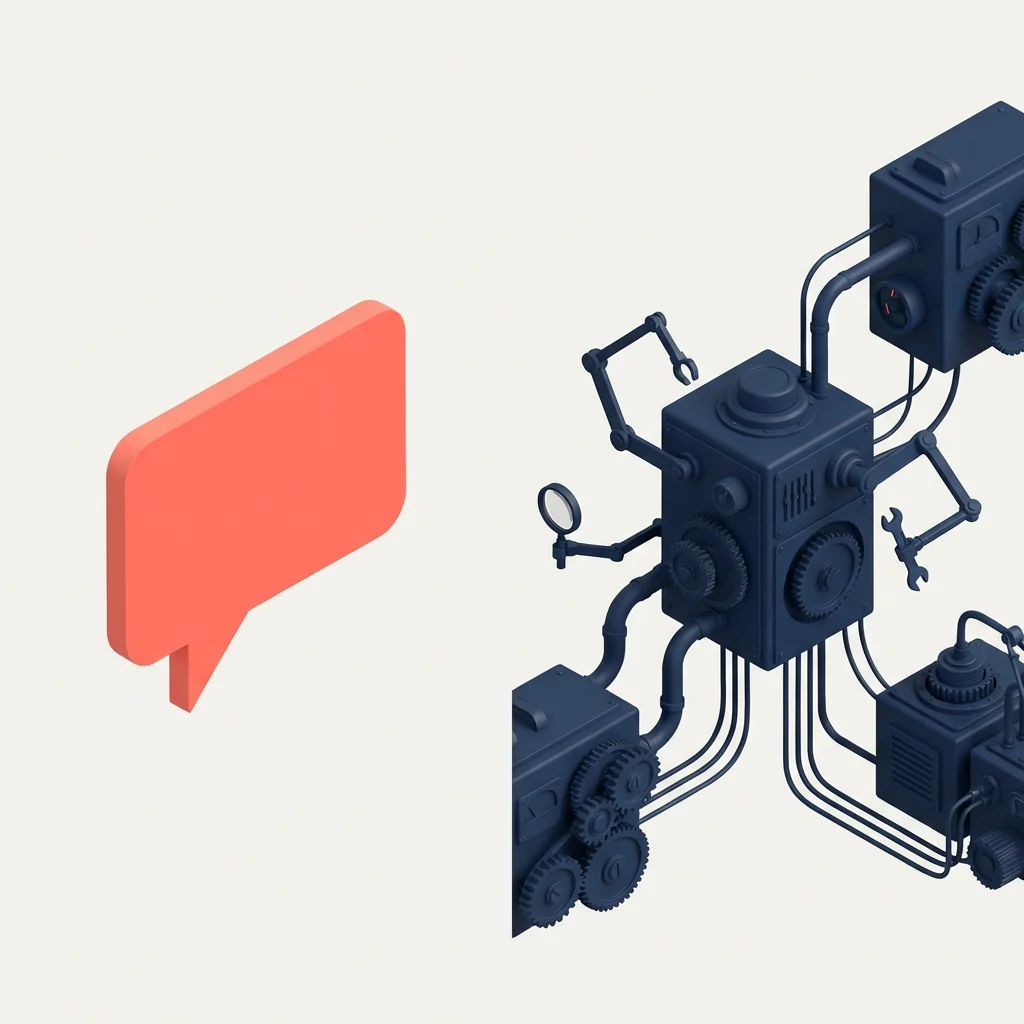
Custom AI agents differ from chatbots in three fundamental ways: they access your systems, execute multi-step workflows, and improve with domain-specific data. Chatbots answer questions. Agents do work.
The Confusion Problem
"We already have ChatGPT" is the most common objection we hear. And it's a reasonable one. ChatGPT, Claude, and Gemini are remarkably capable general-purpose AI tools. They can draft emails, summarize documents, write code, and answer questions across almost any domain.
So why would a business pay for a custom AI agent when they can hand everyone a ChatGPT license for $20/month?
Because there's a fundamental difference between a chatbot and an agent. Understanding that difference is the key to knowing when each one is the right tool.
Chatbots: Conversation Partners
A chatbot is a conversational interface to a language model. You type a prompt, it generates a response. The interaction is synchronous: you ask, it answers.
The leading chatbots right now:
- ChatGPT (OpenAI) for general-purpose conversation and analysis
- Claude (Anthropic) for nuanced reasoning and longer documents
- Gemini (Google) for multimodal tasks with Google Workspace integration
Chatbots are excellent at:
- Answering ad-hoc questions ("Summarize this contract")
- Drafting content ("Write a job description for a senior PM")
- Brainstorming ("Give me 10 ideas for reducing customer churn")
- Light analysis ("What are the key trends in this spreadsheet?")
The common thread: single-turn or short-turn tasks where the human drives every step.
Agents: Autonomous Workers
An AI agent is a system that takes an objective, breaks it into steps, executes those steps across tools and data sources, and delivers a result. The interaction is asynchronous: you define the goal, the agent does the work.
An agent differs from a chatbot in three critical ways:
1. System Access
Chatbots live in a browser tab. Agents connect to your actual systems.
CloneICP runs semantic search across the open web, scores every match using Claude, and delivers ranked results with percentage scores and written reasoning. No human types a prompt. The user describes their ideal customer once, and the agent runs a multi-source search across the open web, returning 20-50 scored matches in under 60 seconds.
ChatGPT can't run semantic people search across the web. It can't score matches against your specific ICP criteria with sourced reasoning. It can't pull real-time profile data from live web sources. A chatbot is limited to what you paste into the chat window.
2. Multi-Step Reasoning
Chatbots handle one request at a time. Agents chain multiple steps together.
SnowThere runs a daily autonomous content pipeline. A cron job triggers research agents that gather data from multiple search APIs. Claude generates comprehensive resort guides. Then three editorial agents (TrustGuard, FamilyValue, VoiceCoach) each evaluate the content and vote. A 2/3 majority is required for publication. That's five steps executed autonomously for every piece of content, every day, across 116 resorts.
To do this with ChatGPT, someone would need to manually research each resort, paste findings into a chat, ask for a draft, then separately evaluate quality by... asking ChatGPT to review its own work (which defeats the purpose of independent review). The "AI" part handles one step. The human handles the other four.
3. Persistent Memory and Context
Chatbots start fresh with every conversation (or at best, retain a limited context window). Agents maintain persistent knowledge about your domain.
JobMap knows what makes a great job description. Not generically. Specifically. It understands role purpose, growth paths, company value propositions, and salary benchmarks across industries. When you describe a role, it generates four structured deliverables (Job Map, Job Ad, Job Deck, Salary Benchmark) that reflect deep domain knowledge about what candidates actually care about.
Ask ChatGPT to "write a job description" and you'll get something competent but generic. It doesn't know what makes your role different. It doesn't know the four-deliverable framework. It doesn't know that candidates care more about growth paths than perks. Domain knowledge is the difference between a smart generalist and a specialist.
The Decision Framework
When to use a chatbot vs. a custom agent:
Use a chatbot when:
- The task is ad-hoc and varies each time
- A human is already at the keyboard and can drive the conversation
- The work requires general knowledge, not domain-specific data
- You need a quick answer, not a repeatable process
Use a custom agent when:
- The task repeats on a schedule (daily, per-event, per-transaction)
- The workflow spans multiple systems (search APIs + scoring + delivery)
- The task requires reading unstructured data (web profiles, research sources, role descriptions)
- You need consistent output quality without human supervision
- The cost of errors is high enough to warrant built-in guardrails
Real Examples: Side by Side
Sales Prospecting
- ChatGPT approach: Sales rep describes ideal customer, asks "Find me prospects." ChatGPT suggests some general search strategies. Rep still has to manually search LinkedIn and build the list. Repeat every week.
- Agent approach (CloneICP): Rep types a plain-English description. Agent runs semantic search across the open web. Claude scores every match 0-100% with reasoning. 20-50 ranked results in under 60 seconds. No manual searching.
Content at Scale
- ChatGPT approach: Writer researches a resort, pastes notes into ChatGPT, asks for a draft. Edits it manually. Fact-checks claims by hand. Repeat 116 times. Budget: months of human labor.
- Agent approach (SnowThere): Daily pipeline researches, generates, and reviews content autonomously. Three-agent editorial panel votes on every piece. 116 resorts published across 16 countries. Budget: $5/day.
Job Descriptions
- ChatGPT approach: HR manager asks "Write a job description for a senior PM." Gets a generic template. Edits it for 30 minutes. Still ends up with something that sounds like every other JD.
- Agent approach (JobMap): Manager describes the role. Agent generates four structured deliverables: Job Map, Job Ad, Job Deck, Salary Benchmark. Each reflects deep understanding of what makes the role unique and what candidates actually care about.
The Build-vs-Buy Question
"Can't we just build agents ourselves with the ChatGPT API?"
Technically, yes. OpenAI's Assistants API, Anthropic's Claude API, and frameworks like LangChain and CrewAI make it possible. But there's a gap between "possible" and "reliable in production."
The hard parts aren't the API calls. They're:
- Prompt engineering that handles edge cases across thousands of inputs
- Error recovery when an API call fails or returns unexpected output
- Human-in-the-loop design that builds trust without creating bottlenecks
- Monitoring and evaluation to catch quality degradation over time
We've seen engineering teams spend 4 months prototyping an internal agent with mixed results. We rebuilt it in 3 weeks using patterns validated across dozens of deployments. The first agent is the hardest. After that, the patterns transfer.
The Bottom Line
Chatbots and custom agents are different tools for different problems. ChatGPT is the right answer when you need a smart conversation partner. A custom agent is the right answer when you need a reliable process that runs without human supervision, connects to your systems, and delivers consistent results at scale.
Most teams need both. The question is knowing which tool fits which problem.
Not sure where your bottleneck falls? Describe it and get an Automation Blueprint that maps the right approach.
Have a similar challenge?
Describe your bottleneck and get a free Automation Blueprint in 60 seconds.